
The Path of Waiting
- Dacxilia S Deras
- 20 hours ago
- 4 min read
This series of five watercolors illustrates a story I don't quite understand—whether it's a love story or a profound struggle against desolation. I will try to guide you through this journey, even though I'm not yet sure where it will lead us. It depicts the inner journey of a Japanese man grappling with an impossible love. There is no explicit drama or external conflict: the tension lies in the restraint, in the silent ethics of loving without possessing. It's ironic how she doesn't appear anywhere, and yet she's present everywhere, and at the same time they are one single being on the same path.
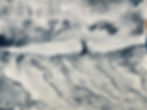
The character walks alone through landscapes that transform—ocean, fields, clouds, dry land, and desert—reflecting the states of the soul. Each space is not a geographical location, but an emotional threshold. The physical journey is, in reality, a meditation on time, renunciation, and fidelity to a feeling that does not seek fulfillment.
The figurative style, permeated by the character's solitude, engages in a dialogue with a sensibility akin to Zen philosophy: accepting what is, walking without demanding, loving without expecting anything in return. Emptiness is not absence, but a space of meaning.
These watercolors do not tell a story of loss, but of permanence. Love is not consummated, but neither does it disappear. It transforms into a journey.
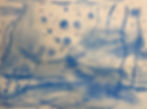
Here the ocean is not an open horizon, but a liquid interior. We don't see the man yet: he is submerged in the experience, not in the body.
The blue patches expand like diluted memories. The water has no fixed direction; everything floats. The vertical algae suggest time, slow growth, roots that don't touch the earth. In the center, a bird—or perhaps a thought—crosses the watery space: it doesn't belong to the sea, but it passes through it.
This first watercolor doesn't speak of absence, but of gestation.
Love doesn't hurt yet because it doesn't demand anything.
It is profound, silent, inevitable.
The ocean here is not a landscape: it is an emotional state.
Before walking, before waiting, before giving up, love exists like this: diffuse, enveloping, without human form.
After the water, the land.
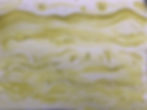
The blue calms and turns pale green, almost golden. The world no longer envelops; it unfolds.
The man appears for the first time, tiny, walking among gentle undulations that neither oppress nor promise. His figure does not dominate the landscape; it traverses it. The fields repeat themselves like a rhythm, like days that pass without visible events, yet are laden with meaning.
The lines of the wind and the swirls in the sky do not announce a storm: they are thoughts that revolve, return, and settle. The vertical plants mark pauses, moments of inner stillness. He continues moving forward without haste, as if he knows that the love he awaits does not need to be pursued.
Walking is the way he finds to love without breaking anything.
In "Roads in Deep Blue Gray," 3/5 the horizon becomes unstable, and the body loses its weight. The man no longer walks: he is suspended in the air as if love had freed him from himself.
The gray and white patches form neither sky nor ground; they form a state of being. Everything is vapor, breath, diluted thought. His dark, elongated figure, almost dissolved by the wind, seems to move forward without touching anything. His hat becomes a minimal anchor: the only thing that still connects him to the world.
Here there is neither waiting nor surrender. There is contained ecstasy, an instant of absolute clarity.
Loving ceases to be distance and becomes total presence, even without a destination.
It is a brief revelation: love can elevate without possessing.
This moment is neither escape nor promise.
Ascent. The path doesn't end, but something along it quiets down.
The landscape no longer presents itself as recognizable territory, but as an atmospheric expanse where color dissolves in soft, breathable layers, and red becomes serene, almost contemplative. The fourth watercolor depicts the moment when the waiting ceases to be tense. The impossible love isn't resolved, but it no longer weighs heavily.
That's why it conveys peace: it's not relief or happiness, but a sense of calm acceptance. The character continues walking, but something within him is already at rest.
The figure moves forward, small and unassuming, integrated into the surrounding space, as if walking were no longer an act of searching but of simply being. There is a silent peace in this scene, not the peace of resolution, but the kind that arises when waiting ceases to be a source of tension and transforms into acceptance. The vast, deliberate emptiness doesn't signify absence, but rather repose: a place where love, even unfulfilled, finds the calm of continuing to exist without demanding anything in return.
The Return to the Earth
Here the body returns to the earth, but it is not the same earth as in the first watercolors.
The mountain—or hillside—occupies a large part of the composition and carries visual weight, but it doesn't oppress, it doesn't disturb.
It's firm, stable presence. It is no longer an obstacle or a changing emotional landscape: it is a resting place.
I think it's important that the journey ends this way, seated, not walking.
That speaks of inner peace, not weariness.
Look, the wind is like movement without displacement. The curved lines in the sky are one of the most beautiful gestures in the entire series.
They don't push the figure. They don't lift him. They don't drag him. They simply flow around him.
This wind is love transformed:
It's presence.
The series builds an experience of waiting that is refined until it becomes calm: a love that is not consummated, but neither does it disappear, and which finds its way of enduring in the act of walking—and ultimately, of dwelling.
I created this small but intense project without rushing, with the sensitivity and spontaneity that working with watercolors affords me.
Watercolor Collection dedicated to Samyueru.
With love for all those who are passionate about impossible love stories...
Suh.